Wire Rope Weight Guide
6 December, 2017
While wire rope is a relatively simple piece of equipment, there are several terms and factors that you must be aware of before you, or any of your staff, operate this gear. Below you will find a handy all-in-one wire rope weight guide.
 It’s important not to exceed the wire rope weight limit
The safe working load (SWL), also referred to as the working load limit (WLL) or the normal working load (NWL), is the figure that you should be operating at whenever using it. It will change depending on the strength of your rope, and is the figure that the manufacturer has deemed safe to work at. You may also see this being referred to as simply the safe load.
On the other hand, the minimum breaking limit (MBL) refers to the absolute maximum a piece of equipment can be operated at before it breaks. This will have been tested by your manufacturer, and is a figure well above that of the SWL.
Take note of all advice offered to you by your manufacturer, as this will help to prolong the service life of your equipment.
It’s important not to exceed the wire rope weight limit
The safe working load (SWL), also referred to as the working load limit (WLL) or the normal working load (NWL), is the figure that you should be operating at whenever using it. It will change depending on the strength of your rope, and is the figure that the manufacturer has deemed safe to work at. You may also see this being referred to as simply the safe load.
On the other hand, the minimum breaking limit (MBL) refers to the absolute maximum a piece of equipment can be operated at before it breaks. This will have been tested by your manufacturer, and is a figure well above that of the SWL.
Take note of all advice offered to you by your manufacturer, as this will help to prolong the service life of your equipment.
 They have also offered an example of the strength of 3/8” wire rope that has a safe working load of 10.9 kN. To determine the strength, the calculation m = F / g is used, where:
Limits that apply to all lifting gear
One of the most important pieces of information, and this applies to any piece of lifting gear that lifts loads, are the safe working load and minimum breaking limit. These are two separate limits, but both apply to the same piece.
It’s important not to exceed the wire rope weight limit
The safe working load (SWL), also referred to as the working load limit (WLL) or the normal working load (NWL), is the figure that you should be operating at whenever using it. It will change depending on the strength of your rope, and is the figure that the manufacturer has deemed safe to work at. You may also see this being referred to as simply the safe load.
On the other hand, the minimum breaking limit (MBL) refers to the absolute maximum a piece of equipment can be operated at before it breaks. This will have been tested by your manufacturer, and is a figure well above that of the SWL.
Take note of all advice offered to you by your manufacturer, as this will help to prolong the service life of your equipment.
Breaking limits
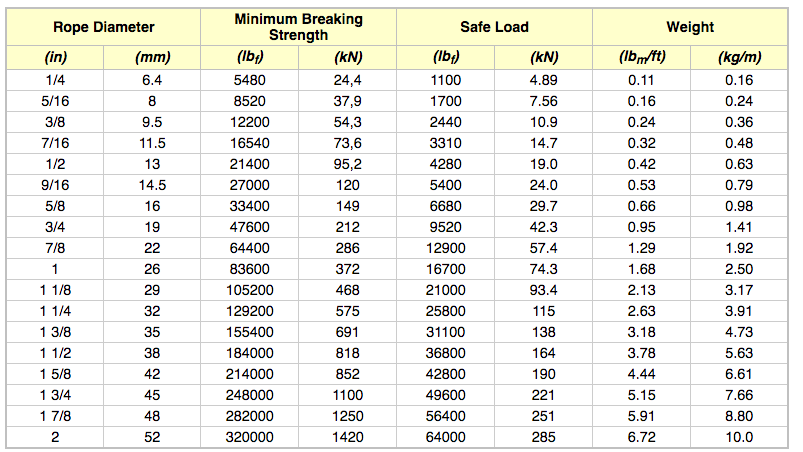
To help demonstrate the breaking limit of wire rope, The Engineering Toolbox have put together this handy table. It lists the strength of improved plow steel (IPS) wire rope that is uncoated and has a fibre core.
They have also offered an example of the strength of 3/8” wire rope that has a safe working load of 10.9 kN. To determine the strength, the calculation m = F / g is used, where:
- m = mass in kilograms
- F = force (weight) in newtons
- g = acceleration of gravity (9.21 m/s2)