Wire Rope Replacement Advice and Discard Criteria
15 November, 2016
Over time many customers have asked us for discard criteria and advice relating to replacement. We have provided some practical advice and guidance on this topic in this latest article.
 There will come a point for all rope to be replaced
Listed below are five reasons why the material may need to be discarded and replaced:
There will come a point for all rope to be replaced
Listed below are five reasons why the material may need to be discarded and replaced:
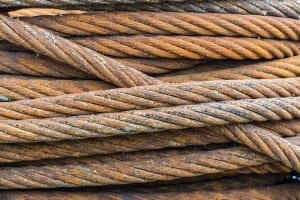 Corroded rope will need to be replaced
Standards compliance
Both the ISO and LOLER standards provide advice relating to the discard and replacement of ropes: · ISO 4309:2010 – The ISO have published standards relating to the discard of ropes, these should be read in conjunction with this article Lifting Operations and Lifting Equipment Regulations 1998 (LOLER) – The regulations specifically state:“don’t use unsuitable equipment, e.g. makeshift, damaged, badly worn chains shortened with knots, kinked or twisted wire ropes, frayed or rotted fibre ropes”
There will come a point for all rope to be replaced
Listed below are five reasons why the material may need to be discarded and replaced:
1) Broken wires and rope replacement
Broken wires are dangerous for a number of reasons; they greatly reduce the load bearing capability and are also dangerous to operators (especially hands). As a general rule broken wires should never exceed 5% of the total wires. Also, where breakages are local this will need the rope to be removed from service.2) Excessive wear
The lifting medium has a distinct life time (and won’t last forever!). Once it has excessive wear the rope will need to be discarded. Once a rope has lost 10% or more of its diameter it needs to be discarded and replaced.3) Corrosion
Corrosion occurs frequently due to poor storage, e.g. exposure to the elements or chemicals. Corroded rope is of no use and highly dangerous. When corroded rope is discovered it should be taken out of service and replaced.
Corroded rope will need to be replaced